
Last Updated: June 2026
Estimated Reading Time: 15 Minutes
Target Audience: Industrial Equipment Procurement Managers, Electrical Engineers, Automation System Designers, Product R&D Directors
The reliability of industrial control panels often hinges on the smallest interactive components. In operating environments characterized by extreme temperatures, high-frequency vibrations, chemical corrosion, or physical abuse, Metal Push Buttons serve as the first and most critical line of defense for a device’s core circuitry. A substandard switch not only results in a poor user experience but can also lead to costly assembly line downtime, expensive after-sales repairs, and even severe safety hazards.
This comprehensive guide will thoroughly dismantle the logic of selecting metal push buttons—from material science and electrical configuration to international protection standards and compliance certifications. Whether you are designing the next generation of EV charging stations, heavy-duty medical machinery, or high-end commercial kiosks, this guide will help you avoid the high costs of trial and error.
📋 In-Depth Guide Directory
- Material Science: Analyzing Shell Materials from a Microscopic Level
- The Limits of Protection: A Deep Dive into IP and IK International Standards
- Electrical and Mechanical Principles: Contacts, Action Logic, and Lifespan Design
- Uncompromising Compliance: Official Certification Systems for Global Market Access
- Troubleshooting: Analysis of Typical Failure Modes in Metal Push Buttons
- Customization and Cost Efficiency: Why an Advanced Supply Chain is Key
1. Material Science: Analyzing Shell Materials from a Microscopic Level {#material-science}
In harsh industrial environments, the shell material of a metal push button directly determines its corrosion resistance and mechanical lifespan. An industrial-grade metal button is never just “a piece of metal”; there is profound material science behind it.
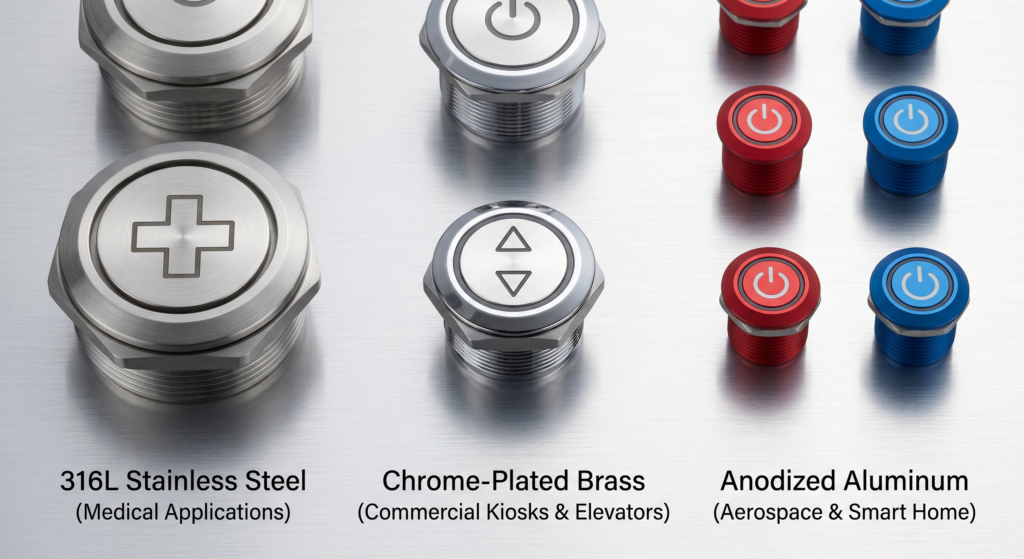
- 304 and 316L Stainless Steel
- Characteristics: Stainless steel is the premier choice for high-end applications. Grade 304 can withstand oxidation in most conventional environments, while Grade 316L has added Molybdenum (Mo), giving it exceptional resistance to chloride ion corrosion.
- Best Applications: Medical operating room equipment (enduring strong disinfectants), marine control consoles (salt spray resistance), and food processing lines.
- Nickel/Chrome-Plated Brass
- Characteristics: Brass inherently possesses excellent machinability and thermal conductivity. After multi-layer nickel or chrome plating, it presents a premium mirror or brushed finish, and its surface hardness is significantly enhanced.
- Best Applications: Commercial elevator buttons, high-end vending machines, coffee machine panels. It strikes an excellent balance between aesthetics and cost.
- Anodized Aluminum
- Characteristics: Aluminum alloy is extremely lightweight. Through the anodizing process, it not only forms a hard aluminum oxide protective film on the surface but also allows colors like red, blue, black, and gold to be dyed into its micropores for industrial indication.
- Best Applications: Aerospace equipment control panels, smart home master control panels requiring minimalist visual design, and portable testing instruments.
💡 Expert Selection Advice: If you are looking for long-lifespan solutions for extremely humid or highly acidic/alkaline environments, we strongly recommend adopting high-strength waterproof metal switch panels made of 316L stainless steel to ensure the physical integrity of your equipment for over a decade.
2. The Limits of Protection: A Deep Dive into IP and IK International Standards {#ip-ik-ratings}
Having a rugged shell alone is not enough; the intrusion of moisture and dust is the number one killer of electronic components. When reviewing procurement specifications, you must rigorously examine the following two standards established by the International Electrotechnical Commission (IEC):
IP Rating System (Ingress Protection)
The IP code consists of two digits: the first represents dust protection, and the second represents water protection.
- IP65: Totally protected against dust ingress and protected against low-pressure water jets. Suitable for general indoor factory environments.
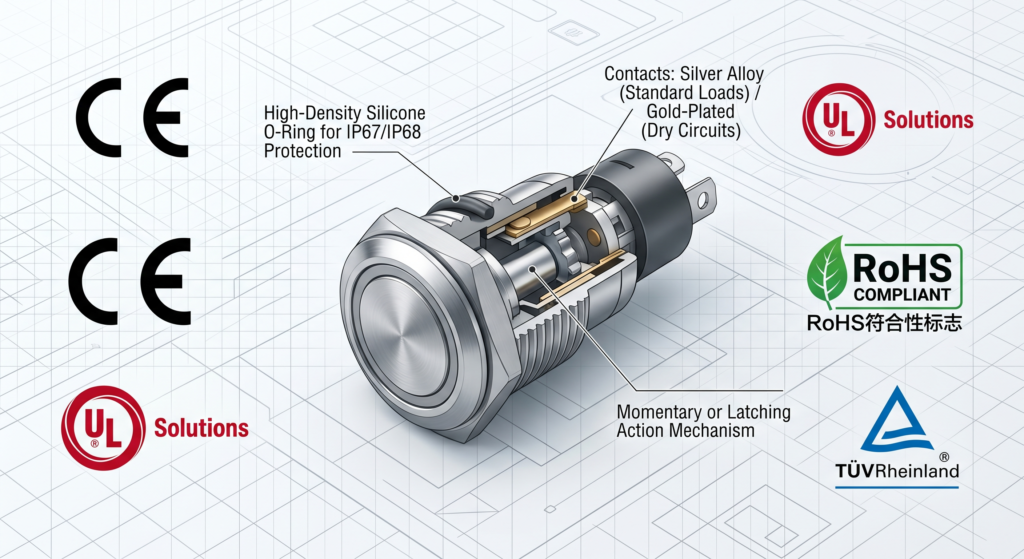
- IP67: The baseline for industrial grade. Totally protected against dust and can be submerged in water up to 1 meter deep for 30 minutes without leaking. Internally, this is usually achieved using high-density silicone O-rings and deep epoxy resin sealing processes.
- Official Resource: For a deeper understanding of the testing procedures, please refer to the IEC Official Guide on IP Ratings.
IK Rating System (Impact Protection)
According to the EN 62262 standard, the IK rating measures the enclosure’s capacity to withstand external mechanical impacts, ranging from IK00 to IK10.
- IK08: Can withstand an impact of 5 joules (equivalent to a 1.7kg mass dropped from 30cm).
- IK10: The highest anti-vandal level for metal buttons, capable of withstanding a 20-joule impact (a 5kg mass dropped directly from 40cm). For equipment exposed in public areas (e.g., parking meters, prison intercoms), IK10 is a mandatory requirement.
3. Electrical and Mechanical Principles: Contacts, Action Logic, and Lifespan Design {#electrical-mechanical}
The “heart” of a metal push button is its internal microswitch. The accuracy of the electrical configuration dictates the smoothness of the entire circuit logic.
Precise Matching of Action Logic
- Momentary: Closes when pressed, opens immediately when released. The mechanical lifespan usually exceeds 1,000,000 cycles. Widely used with PLCs and relays to trigger software logic.
- Latching (Maintained): Physically locks into place and keeps the circuit closed when pressed; pops back up and opens the circuit only when pressed again. Mechanically more complex, with a lifespan typically around 500,000 cycles. Suitable for direct control loops like fans and lighting without MCU intervention.
Contact Material and Load Matching
- Silver Alloy Contacts: The standard configuration. Excellent conductivity, capable of handling large inrush currents (e.g., 5A/250VAC), making it suitable for driving motors or high-power lighting.
- Gold-Plated Contacts: Specifically designed for micro-currents / dry circuits. If your button is connected to a microprocessor (MCU) where the operating current is only a few milliamperes, standard silver contacts might fail to transmit signals due to surface oxidation films. Gold-plated contacts ensure absolute conduction in low-voltage, low-current environments.
4. Uncompromising Compliance: Official Certification Systems for Global Market Access {#certifications}
In a globalized supply chain, certification marks on electronic components are not just endorsements of quality; they are legal credentials required for products to smoothly clear customs and be legally sold in various countries. During procurement, you must require suppliers to provide the following certificates:
| Certification Mark | Applicable Region & Core Requirements | Official Verification Platform |
| CE | Mandatory for the EU Market. Proves the product complies with the EU’s Low Voltage Directive (LVD) and Electromagnetic Compatibility (EMC) Directive, ensuring basic fire and shock safety. | European Commission CE Marking Info |
| UL | The De Facto Highest Standard in North America. UL Laboratory’s fire resistance and electrical breakdown tests are extremely rigorous, serving as a core metric for North American buyers and insurance companies. | UL Solutions Global Database |
| RoHS | Global Environmental Consensus. Strictly restricts the use of ten hazardous chemical substances, including lead (Pb), mercury (Hg), and cadmium (Cd), in electrical and electronic equipment. | EU RoHS Directive Official Text |
| TÜV | Top European Third-Party Inspection. Certification from TÜV Rheinland in Germany signifies that the product meets German precision engineering standards in mechanical durability and functional safety. | TÜV Rheinland Official Website |
5. Troubleshooting: Analysis of Typical Failure Modes in Metal Push Buttons {#troubleshooting}
Even when purchasing high-spec products, improper installation and usage can still lead to equipment downtime. Here are three major failure modes summarized by senior engineers and their prevention strategies:
- LED Burnout or Dimness
- Cause: Voltage mismatch. Directly wiring a 12V illuminated button into a 24V industrial power supply.
- Solution: Clearly state the rated voltage of the built-in step-down resistor in your Bill of Materials (BOM). Purchase models with a wide-voltage adaptation range.
- Mechanical Jamming or Failure to Rebound
- Cause: Excessive heat during manual soldering (soldering iron lingering for over 3 seconds) causes the internal plastic base of the button to melt and deform, jamming the spring.
- Solution: Strictly control the soldering process, or directly adopt Pre-wired Sockets/Pigtails to completely eliminate the risk of thermal damage.
- Water Seepage and Short Circuits at Panel Gaps
- Cause: The mounting hole tolerance is too large, or the operator forgot to install the high-density waterproof O-ring included with the switch.
- Solution: Strictly follow product drawings (e.g., precise 16.2mm or 22.2mm laser cutouts) and use a torque wrench to tighten the hex nut, ensuring perfect compression of the sealing ring.
6. Customization and Cost Efficiency: Why an Advanced Supply Chain is Key {#customization-cta}
In today’s highly competitive industrial equipment manufacturing sector, standardized components often fail to meet personalized design needs. From special laser-engraved illuminated symbols (like your custom brand logo) and pre-cut custom wire harness lengths to special grease fillings for extreme cold regions (-40°C), advanced customization capability is the ultimate touchstone for screening premium suppliers.
A professional supply chain provides not just products, but a leap in assembly efficiency and a drastic reduction in after-sales costs.
Are you ready to secure world-class control components for your next engineering project?
As a professional manufacturer deeply rooted in the field of industrial control switches, we understand the weight of every detail. Whether you need miniature 12mm precision switches or heavy-duty 40mm anti-vandal E-stops, we provide one-stop solutions encompassing full CE/UL certifications.
👉 Click here to visit the official SNHCHSYL platform today to access our latest 2026 product catalog, CAD 3D drawings, and engineering test reports. Submit your parameters and pain points to our senior technical team, and we will provide you with highly efficient B2B custom services, from drawing validation to free sampling.