
Last Updated: June 2026
Reading Time: 10 minutes
Author: JingWang Technical & Content Team
Introduction
“Just install any standard off-the-shelf switch; they all do the same thing.” Many procurement managers and engineers fall into this trap during the early stages of project development. That is, until the equipment is deployed outdoors and faces heavy downpours, scorching UV rays, freezing winter temperatures, or violent, repetitive impacts in heavy industrial environments.
When a standard plastic button cracks, leaks, or shorts out, it can bring an entire multi-million dollar production line or critical public infrastructure to a grinding halt.
While ordinary plastic switches may seem to lower initial procurement bills, the hidden downstream costs—including equipment downtime, emergency technician dispatches, and damaged brand reputation—can easily skyrocket to hundreds of times the price of the switch itself. In demanding environments, an industrial metal push button switch is not just a minor component; it is the first line of defense for system safety and operational continuity.
In this comprehensive guide, you will learn:
- Why standard plastic switches fail prematurely in harsh environments (The Truth About Aging Plastics).
- Deep dive comparison of core metal materials (Stainless Steel, Nickel-Plated Brass, Anodized Aluminum).
- The real-world engineering metrics behind IP waterproof ratings and IK impact protection ratings.
- International compliance and regulatory certifications (CE, UL, RoHS, REACH) required for global markets.
- Application-specific selection strategies (EV Charging, Medical, Industrial Automation).
- A 5-step pre-purchase checklist to streamline your RFQ process.
💡 Quick Takeaway: For high-frequency use or unforgiving environments, metal push buttons featuring IP67 waterproofing and IK10 vandal resistance have become the gold standard for modern industrial equipment. Explore the full JingWang Metal Push Button Series to find the exact specifications for your next build.
Why Plastic Switches Fail in Industrial Environments
(The Technical Reality of Component Degradation)
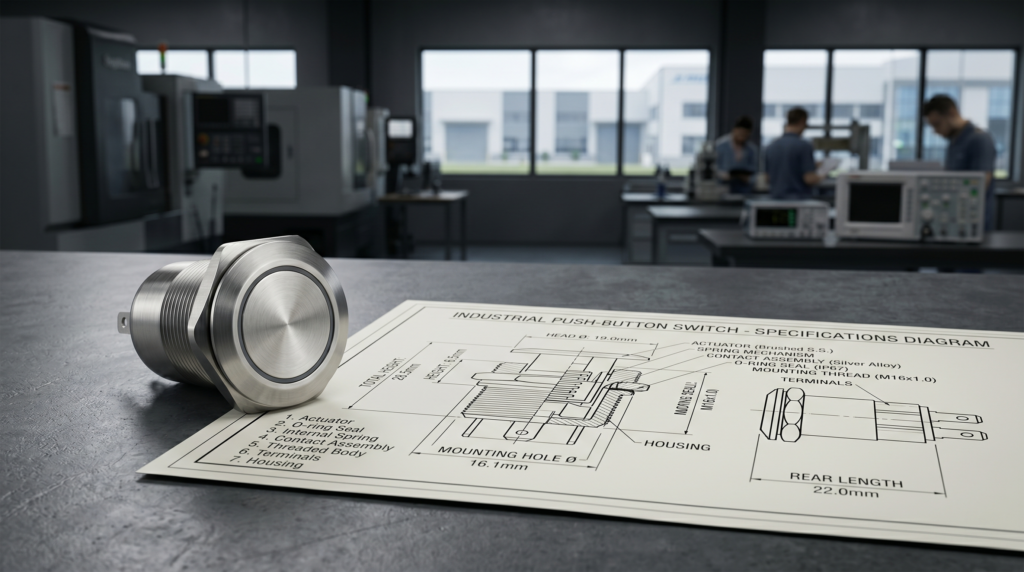
Inside a Standard Plastic Switch:
- External Shell: Commercial-grade engineering plastics (typically PC or ABS).
- Internal Mechanics: Standard tension springs with exposed, non-sealed contact points.
- Moisture Barrier: Basic rubber O-ring or completely unsealed housing.
The Breakdown Hazards:
❌ Abysmal Impact Resistance: Standard plastics cannot withstand heavy impacts, accidental drops, or deliberate vandalism. Their structural rating typically falls below IK04, leaving them vulnerable to fracturing when struck by hard objects in public spaces.
❌ UV and Thermal Degradation: Continuous exposure to solar ultraviolet (UV) radiation breaks down polymer chains. Over time, plastic housings turn brittle, discolor, yellow, and develop micro-cracks that compromise structural integrity.
❌ Seal Failure Leading to Short Circuits: Extreme temperature fluctuations cause rapid thermal expansion and contraction. Because plastic and rubber expand at drastically different rates, the waterproof seals quickly warp and degrade. Once moisture, condensation, or industrial airborne dust penetrates the internal electrical contacts, catastrophic short-circuiting occurs.
The Bottom Line: While plastic buttons may cut upfront component costs by 30% to 50%, their Mean Time Between Failures (MTBF) in outdoor or heavy-duty industrial settings is less than one-fifth that of a high-quality metal counterpart. Head over to https://snhchsyl.com/ to compare the durability metrics of ruggedized metal switches against traditional hardware.
Metal Button Core Materials: A Deep Dive
(Not All Metals are Created Equal)
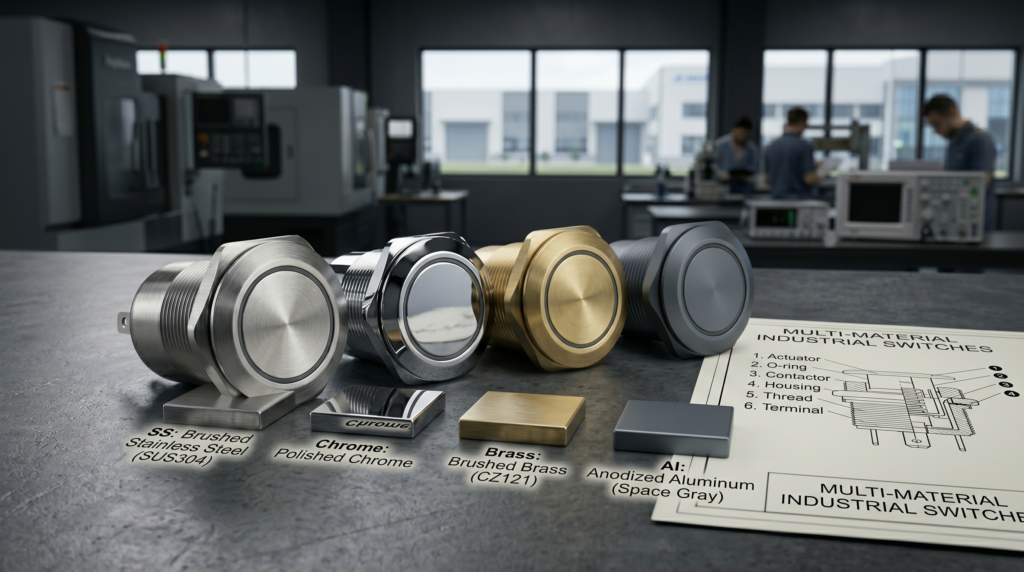
At JingWang’s precision manufacturing facilities, we engineer switches using three primary metal substrates to solve distinct environmental and operational challenges:
1. Stainless Steel (SUS 304 & SUS 316) — The Ultimate Industrial Shield
- Material Profile: Premium chromium-nickel alloy that self-generates an invisible, microscopic passivated anti-oxidation film.
- Key Advantages:✅ Extreme Mechanical Durability: Highly resistant to physical abrasions, scratches, and heavy scratching; maintains a clean finish after a decade of use.✅ Superb Chemical Resistance: The 316-grade variant withstands aggressive industrial washdown chemicals, medical disinfectants, and marine salt spray.
- Limitations: Higher raw material and precision machining costs.
- Best Suited For: Outdoor EV charging stations, medical patient monitors, food processing machinery, marine equipment, and petrochemical controls.
2. Nickel-Plated Brass — The Cost-Effective Workhorse
- Material Profile: High-conductivity brass core finished with an electroplated layer of micron-precise nickel, yielding a premium silver metallic sheen.
- Key Advantages:✅ Excellent Cost-to-Performance Ratio: Offers the look, feel, and weight of stainless steel at a significantly lower production cost.✅ Machining Versatility: Highly receptive to complex structural threading and ultra-low profile configurations.
- Limitations: ❌ If the protective nickel plating is deeply scored by sharp tools, the underlying brass can oxidize and tarnish when exposed to prolonged moisture.
- Best Suited For: Indoor industrial control enclosures, commercial elevator control panels, and standard automated factory assembly lines.
3. Anodized Aluminum — The Designer’s Choice
- Material Profile: Lightweight aluminum alloy treated via an electrochemical anodizing process to form an ultra-hard, vibrant oxide layer.
- Key Advantages:✅ Rich Palette Customization: Available in deep blacks, vibrant reds, blues, greens, and golds to facilitate immediate, color-coded functional zoning on control decks.✅ Lightweight Engineering: Ideal for weight-sensitive portable diagnostics or aerospace instrument clusters.
- Limitations: ❌ Lower surface hardness compared to stainless steel; prone to minor scuffing under abrasive, high-impact conditions.
- Best Suited For: High-end audio-visual consoles, avionics cockpits, premium consumer electronics, and custom automotive control interfaces.
💡 Want to inspect the real-world surface finishes and precise dimensional drawings of these materials? Browse the JingWang Product Center.
Key Performance Metrics & International Certifications
(Navigating Regulatory and Environmental Compliance)
For international B2B procurement—especially when exporting to European and North American markets—safety and environmental certifications are non-negotiable legal requirements. When auditing a supplier, ensure your metal switches carry these credentials:
1. Safety & Electrical Compliance
- CE Marking (European Conformity): 💡 The mandatory entry pass for the European Economic Area. This ensures the metal switch meets stringent low-voltage directives, verifying dielectric strength, insulation resistance, and operational safety under maximum rated current (e.g., AC/DC 24V, 110V, 220V).
- UL / cUL Recognition: 💡 The premier safety standard for North America. UL testing evaluates internal polymer insulation to guarantee flame-retardant performance (e.g., UL94-V0 compliance) and rigorously tests contact lifespan under inductive and resistive loads.
- TÜV / VDE Labels: Certified by leading German independent test houses, representing top-tier manufacturing consistency and supreme long-term electrical reliability.
2. Environmental & Material Sustainability
- RoHS Directive Compliant: ❌ Strictly bans the use of lead, mercury, cadmium, and other hazardous substances. Every switch from SNHCHSYL—from the outer stainless steel casing to the internal silver alloy contact points—is 100% RoHS compliant, bypassing strict green trade barriers.
- REACH Regulation: Guarantees that the components contain zero Substances of Very High Concern (SVHC), verifying safety for human contact and ecological disposal in medical and high-end consumer sectors.
3. Ruggedization Ratings
- IP Ratings (Ingress Protection): IP67 classification guarantees total protection against dust ingress and complete waterproofing against temporary immersion in water up to 1 meter deep for 30 minutes. This is the baseline standard for outdoor infrastructure.
- IK Ratings (Impact Protection): IK10 is the highest rating for vandal resistance, indicating the switch can absorb a direct 20-joule blow (equivalent to a 5 kg steel element dropped from a height of 40 cm) without sustaining internal functional damage.
👉 Need to secure official PDF copies of our compliance certificates for your engineering audit? Get in touch with the JingWang Compliance Team.
SNHCHSYL Decision Matrix & Real-World Use Cases
(Engineering Solutions for Real-World Deployments)
Case Study 1: EV Charging Infrastructure (Public EVSE)
- Environmental Pressures: 24/7 unprotected outdoor deployment, torrential rains, intense UV exposure, sub-zero winter freeze, and potential vandalism.
- Engineered Selection: SUS 304/316 Stainless Steel + Bi-Color LED Ring + IP67 Waterproofing + IK10 Vandal Proofing + CE/UL Listings.
- The Rationale: The stainless steel chassis completely eliminates rust hazards. Integrated LED status rings provide intuitive user guidance (e.g., Red for Fault, Green for Charging), while the maximum IK rating ensures the station withstands physical abuse in public parking lots.
Case Study 2: Clinical Medical & Pharmaceutical Processing Line
- Environmental Pressures: Daily exposure to aggressive chemical wipes, high-pressure sanitization, and a strict requirement for zero biological accumulation zones.
- Engineered Selection: SUS 316L Stainless Steel + Ultra-Flush/Flat Design + IP67 + RoHS/REACH Certifications.
- The Rationale: 316-grade steel resists localized pitting from medical-grade sterilizers. The ultra-flat design eliminates crevices where bacteria or particulates can accumulate, ensuring total compliance with hygienic manufacturing regulations.
👉 We maintain a robust OEM/ODM portfolio across these demanding industries. Check out our JingWang Industrial Case Studies & Application Notes.
The 5-Step Buyer Checklist Before Placing Your Order
(Streamline Your Sourcing Process)
Before contacting our engineering team for an RFQ, please verify these five core parameters to receive an accelerated, pinpoint quote:
- [ ] Mounting Hole Diameter: Map out your panel layout. Standard industrial cutouts are available in 12mm, 16mm, 19mm, 22mm, or 25mm configurations.
- [ ] Switching Action:
- Momentary: The switch remains active only as long as it is physically held down (e.g., a doorbell or horn circuit).
- Latching: Press once to click and lock the circuit into an active state; press again to release and open the circuit (e.g., a master power toggle).
- [ ] Illumination Profile: Determine if your panel requires LED indicators. Select your configuration (Ring, Dot, or Power Symbol) and specify your exact driving voltage (e.g., 5V, 12V, 24V, 110V, 220V).
- [ ] Terminal Wiring Interface: Choose between quick-connect solder pins, screw terminals, or pre-wired pigtails to minimize your down-line factory assembly labor costs.
- [ ] Regulatory Mandates: Identify your target regional markets. If your equipment is destined for North America, mention your need for UL recognition so our team can provide pre-approved components.
Conclusion & Ordering Info
(Make the High-ROI Choice)
- Standard Plastic Switches: Low initial component cost, but burdened with frequent maintenance cycles, elevated warranty liabilities, and predictable failures in challenging environments.
- Premium Metal Switches: A slightly higher upfront component investment that pays immediate dividends via IP67-rated waterproof seals, IK10 impact security, and a physical lifespan exceeding a million operations.
For industrial original equipment manufacturers (OEMs) looking to elevate equipment value and eliminate field service overhead, integrating premium metal switches is one of the highest-ROI engineering decisions you can make.
As a dedicated global provider of industrial switching components, JingWang is committed to delivering high-performance, fully certified hardware to manufacturing lines worldwide.
Ready to Optimize Your Equipment Control Panels?
Send us your layout specifications—including cut-out dimensions, material choices, LED color requirements, and target compliance regulations. Our application engineers will deliver full technical drawings, cross-reference support, and a competitive commercial quote within 24 hours.