
Last Updated: June 2026
Reading Time: 10 Minutes
Target Audience: Electrical Engineers, Procurement Managers, Industrial Automation Designers
In the design of high-end industrial equipment, medical devices, and high-tech commercial terminals (like premium coffee machines and smart EV charging stations), the visual feedback and tactile feel of the control panel are at the core of the user experience. LED Illuminated Metal Push Buttons perfectly combine the rugged durability of stainless steel with the informational indication of LED lights, making them an indispensable component for modern, high-quality equipment.
However, in actual engineering procurement and assembly, engineers often face numerous challenges: burned-out LEDs, mismatched voltages, confusing wiring logic, or inflated ingress protection (IP) ratings leading to water ingress and short circuits. This guide will deeply unpack the mysteries of selecting illuminated metal push buttons from the perspectives of electrical principles, industrial standards, and practical assembly, helping you avoid costly trial-and-error in design and production.
📋 Quick Navigation
- The Cornerstone of Operation Logic: Momentary vs. Latching
- LED Visual Design: Illumination Types and Industrial Color Standards
- Overcoming Core Pain Points: Voltage Matching and Wiring Logic (NO/NC/C)
- The Invisible Defense: IP Ratings and Resin Sealing Processes
- Cost Reduction and Efficiency: Why You Need Custom Pre-Wired Harnesses
- Get Your Exclusive Control Panel Solution
1. The Cornerstone of Operation Logic: Momentary vs. Latching {#operation}
Before choosing any appearance or style, the underlying logic of the electrical control system must be determined. Illuminated metal buttons typically offer two basic operation modes. A wrong choice will directly cause the equipment to malfunction.
- Momentary: The circuit is connected (or disconnected) when pressed, and the button immediately springs back to its original position when the finger is released, restoring the circuit state.
- Typical Applications: PC power buttons, jogging control for robotic arms, “Push to Exit” buttons in access control systems, and signal inputs in PLC control systems. In automation systems, momentary buttons are often used with contactors for higher safety.
- Latching (Maintained): When pressed, the button depresses and locks, keeping the circuit connected; it only pops up and disconnects the circuit when pressed a second time.
- Typical Applications: Fan switches, lighting controls, continuous start-stop of conveyor belts. It doesn’t need an extra relay to maintain the circuit state, making it suitable for simple, direct control loops.
💡 Engineer’s Tip: For modern equipment requiring coordination with Microcontroller Units (MCU) or PLC programming, we highly recommend using Momentary buttons. The state locking is handled by software logic, and the LED light indicates the current status. This not only ensures a longer mechanical lifespan but also avoids system crash risks caused by physical button jamming.
2. LED Visual Design: Illumination Types and Industrial Color Standards {#led-design}
LED indicators are not just for aesthetics; they are crucial safety signals for Human-Machine Interfaces (HMI).
Choosing the Illumination Style
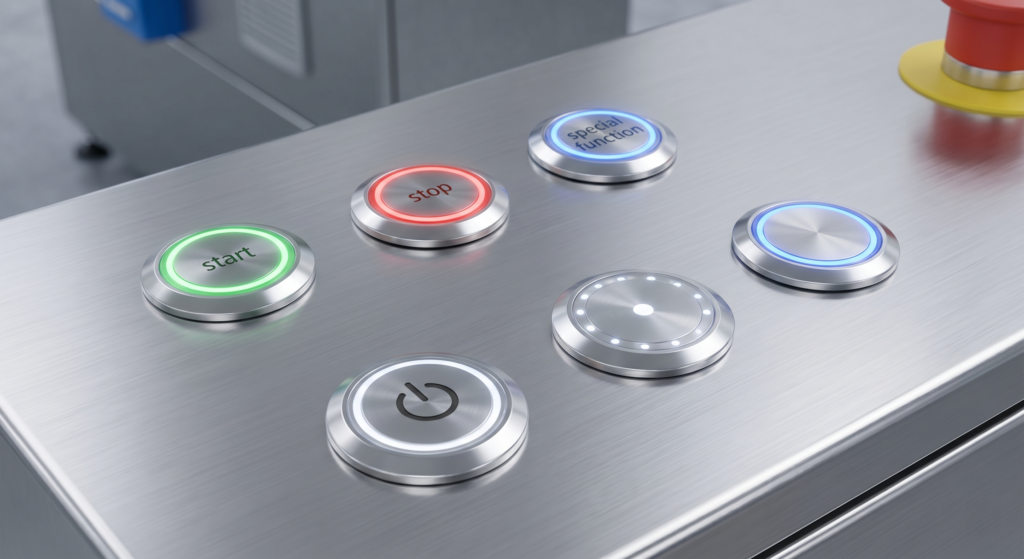
- Ring Illuminated: The most premium and popular design for modern equipment. Light is evenly distributed around the button’s edge, offering a highly technological feel. Ideal for EV charging stations and high-end audio equipment.
- Dot Illuminated: Features a small glowing dot in the center. Vintage and understated, suitable for industrial instruments with compact spaces and lower ambient brightness requirements.
- Power Symbol: Directly illuminates the internationally recognized power icon (⏻). Clear and intuitive, making it the top choice for main power controls across various devices.
Adhering to IEC 60073 International Color Standards
To ensure global user safety and uniform cognition, control panel colors cannot be chosen at random. According to the IEC 60073 Standard – Basic and safety principles for man-machine interface, color definitions are strictly regulated:
| LED Color | Industrial Meaning | Typical Application Scenarios |
| Red | Danger, Emergency, Fault | Emergency Stop (E-Stop), System overload alarm, Halt command |
| Green | Safety, Normal, Start | Equipment running normally, Motor start, Ready to operate |
| Yellow / Orange | Warning, Abnormal Intervention | Standby state, Operator attention required, Over-temperature warning |
| Blue | Mandatory Action, Special State | Start defrost, Activate special mode, Water circuit control |
| White | Neutral, General Information | Power connected (but not running), Lighting switch |
3. Overcoming Core Pain Points: Voltage Matching and Wiring Logic (NO/NC/C) {#wiring}
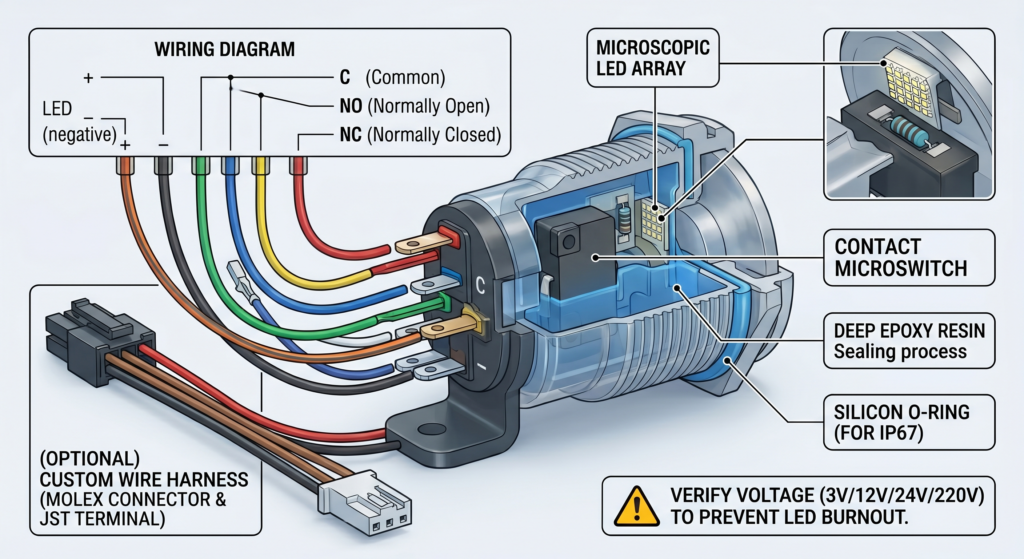
This is the most error-prone step in electrical assembly. A typical illuminated metal switch usually has 5 to 6 pins on the back.
Decoding Pin Identifications
- + and –: Power supply terminals for the LED (if using Alternating Current (AC), polarity does not matter).
- C (Common): The common terminal, the starting point of power input.
- NO (Normally Open): Before pressing the button, C and NO are disconnected; they connect upon pressing.
- NC (Normally Closed): Before pressing the button, C and NC are connected; they disconnect upon pressing.
The Fatal Issue of Voltage Mismatch
The internal LEDs are tiny and highly sensitive to voltage. Common rated voltages include 3V, 6V, 12V, 24V, 110V, and 220V.
- Built-in Step-down Resistors: High-quality switches integrate precision step-down resistors internally. For example, if you purchase a switch labeled 24V, you simply connect it to a 24V DC power supply, and it will light up normally.
- Burnout Risks: If a 12V switch is mistakenly connected to a 24V circuit, the LED will burn out and short instantly. Conversely, if a 24V switch is connected to a 12V circuit, the light will be extremely dim or won’t light up at all. You must confirm the control loop voltage of your equipment before purchasing!
4. The Invisible Defense: IP Ratings and Resin Sealing Processes {#protection}
Compared to non-illuminated pure metal buttons, illuminated ones have an added light-transmitting ring (usually made of Polycarbonate/PC). The seam between these two different materials is the weakest point for moisture and dust intrusion.
- The Hidden Dangers of Cheap Products: Using inferior rubber O-rings or having excessive assembly tolerances can cause gaps to form around the LED ring during outdoor temperature fluctuations (thermal expansion and contraction). This allows rainwater to seep in, directly causing the mainboard to short circuit.
- High-Quality Solutions: Top-tier manufacturers utilize a deep Epoxy Resin sealing process between the metal shell and the illuminated ring, supplemented by high-density silicone waterproof O-rings. This ensures the button remains completely watertight even under extreme IP67 (1-meter underwater submersion) or IP68 conditions.
If you are developing outdoor car washes, yacht control panels, or chemical fluid equipment, you must request explicit waterproof test reports from your supplier. To ensure your equipment is foolproof in harsh environments, you can directly check the SNHCHSYL High-IP Rated Illuminated Metal Push Button Series, all of which have passed rigorous salt spray and submersion tests.
5. Cost Reduction and Efficiency: Why You Need Custom Pre-Wired Harnesses {#harness}
For mass-production equipment manufacturers, assembly efficiency equals profit. Traditional pin soldering (soldering iron) has three major drawbacks:
- High Labor Costs: Soldering 5 tiny pins one by one is extremely time-consuming.
- High Defect Rate: Prolonged soldering time or excessively high temperatures (over 300°C for more than 3 seconds) can easily melt the internal plastic parts, causing the switch to jam or the contact spring to fail.
- Difficult Maintenance: If a button gets damaged, maintenance personnel must re-solder it on-site, which is highly inconvenient.
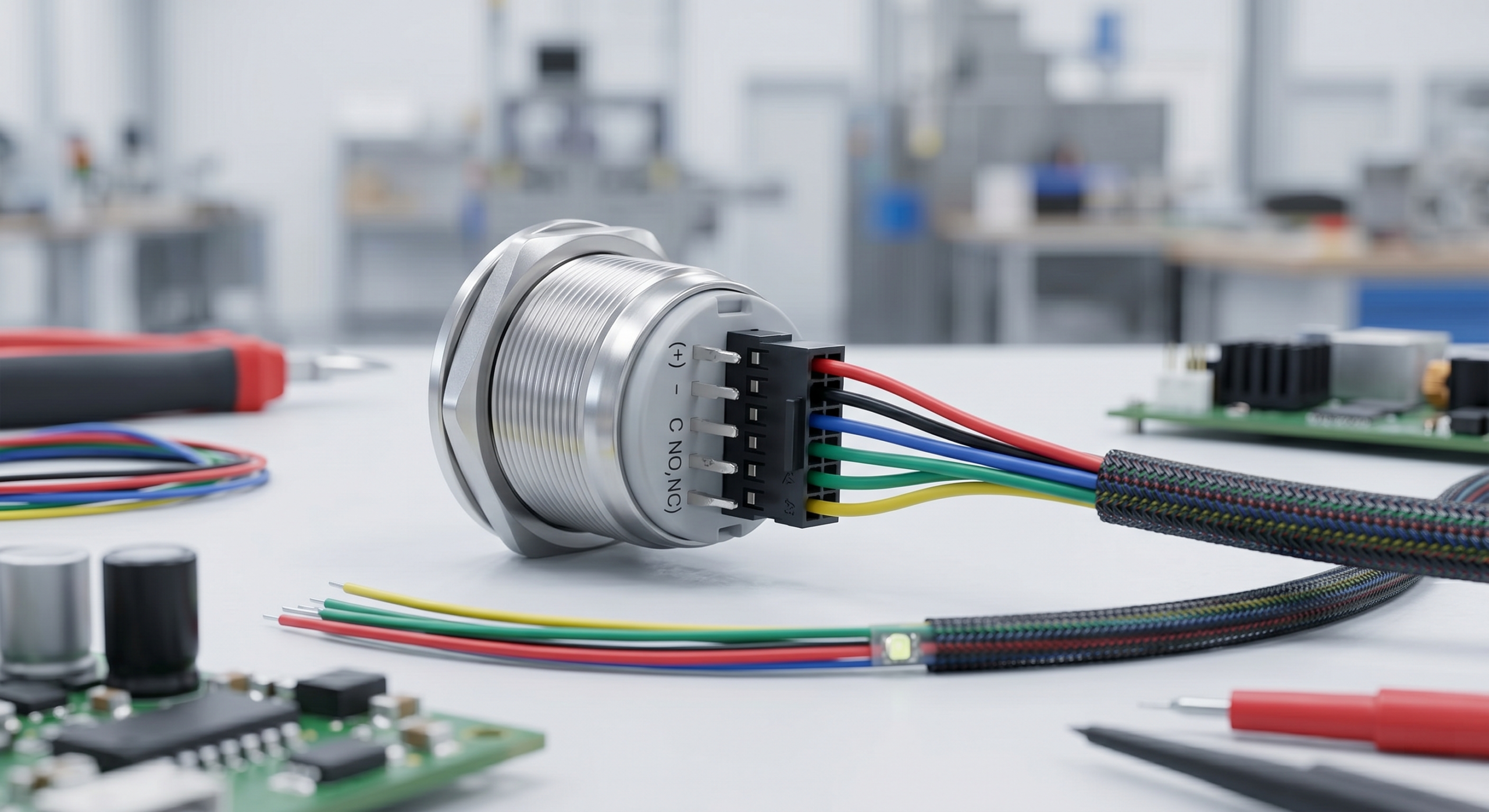
Professional Procurement Advice: Look for suppliers capable of providing “Pre-wired Connectors / Pigtails”. With a customized quick-connect socket (tailored length, wire gauge like AWG22, and terminals like JST or Molex), assembly line workers can complete the installation with a simple “click.” This not only reduces assembly time per unit by 80% but also completely eliminates the risks of cold solder joints and thermal damage.
6. Get Your Exclusive Control Panel Solution {#cta}
Excellent metal control components are a shortcut to elevating the Perceived Value of your equipment. A metal button with a crisp tactile feel, uniform lighting without dark spots, and a mechanical lifespan of up to a million cycles can build deep trust with your customers the very first second they touch the machine.
In the realm of control switches, selection errors often come at a high price. Don’t let a cheap, few-dollar button ruin the reputation of a piece of equipment worth thousands.
👉 Visit the SNHCHSYL Official Website Now to browse our complete line of LED illuminated metal push buttons. Whether you need miniature 12mm dashboard switches, heavy-duty 30mm anti-vandal buttons, or deep customization like pre-wired harnesses and laser engraving, our engineering team is ready to provide you with professional and rapid B2B responses. Tell us your requirements, and let’s light up your next blockbuster device together.
Tags: Illuminated Metal Push Button, LED Anti-Vandal Switch, Stainless Steel Switch, Industrial Controls, IP67 Switch, Wiring Guide, Custom Wire Harness